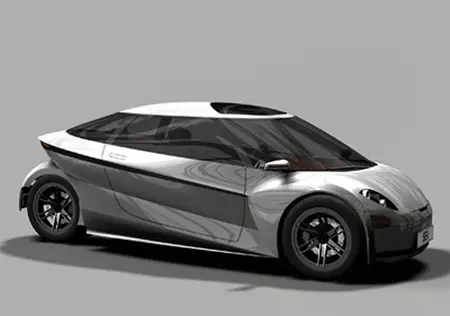
(click to enlarge)
Dutch version of the "SEV explained"
Why not slim down our favorite mode of transportation?
Most people perceive small cars as cheap, unsafe, not comfortable. Why not change the perspective? There's cars and there's motorcycles... and nothing decent in between. Why not a 'Best of Both Worlds'? Here's one - it's called Space-Efficient Vehicle (SEV). The safety and comfort of a car, and the agility and fuel economy of a motor scooter. Not a "it's a grim world out there" type of vehicle, but a lean, clean transport machine that's cheaper to run and a hoot to drive. No need for bio fuels which increases the cost of food production just to feed our gas-guzzlers. No need to go to war to safeguard oil supplies, or for more asphalt at the expense of our living environment.

(click to enlarge)
Space
Efficient
Vehicle
The missing link
With the front looks of a regular car and the rear cowling reminiscent of the tail of a big motorcycle cruiser, the ‘crossover’ I have in mind simply falls into a new category. Single occupant use of the carpool lane in a three-wheel vehicle is allowed in most U.S. states. Dependent on legislation and vehicle regulations the SEV will have a (semi)tricycle platform. This provides better protection against rear impacts and better steering input due to the ability to swivel. The wheel layout enables a long wheelbase relative to overall length and a tapered, streamlined shape, which in turn gives the driver superior all around visibility. There's no passenger next to the driver to block his side view. The driver is able to maintain eye contact with the passengers via the interior mirror. Lane Assist (already standard issue on many cars) helps the driver to maintain lane position.

No pressure... Just a clever extra option
The long term expectations are that car ownership will increase, especially once the economy has picked up again. This means more cars on the road. The Space-Efficient Vehicle (SEV) I am proposing is sleek enough to let governments utilize the infrastructure far more efficiently. The possibilities include opening up smaller -designated- lanes, allowing semi split-lane use (not side by side), reconfigured parking lots and space-efficient interfaces with public transport. Many governments are planning to introduce road pricing. The more eco-friendly the vehicle, the lower the tariff. A lightweight construction allows for 'lean manufacturing' and savings that may actually raise profit margins, and will improve a manufacturer's overall emission and CAFE profile. It would also be an excellent export product, particularly to countries that cope with severe air pollution and outdated, inflexible infrastructures.

(click to enlarge)
Smart For Three
"Build it
and they will come"
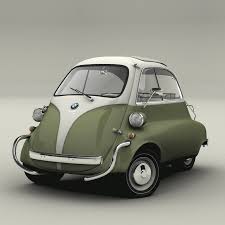
Over the past years iconic small cars like the Mini, the Fiat 500 and the VW Beetle were succeeded by fashionable newer (and larger) versions. But still no new Isetta or new Messerschmitt. Now there's a market just waiting to be explored! Let's take a look at another icon. If you compare the Space-Efficient Vehicle to the Smart ForTwo, then you may notice that the SEV -1- is more practical with its three-seat capacity -2- more energy-efficient due to its sleek profile -3- inherently safer and -4- more comfortable, due to its long wheelbase.

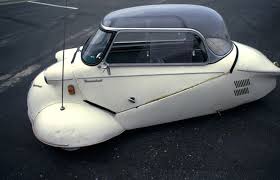
Left: Messerschmitt
Right: Smart ForTwo
Below: Saab 92 and BMW Isetta

More and more people have more than one car... By 'differentiating' car use they will be able to actually save time, save fuel, save money and save the environment. If you are just on your own, going back and forth to work for instance, take the Space-Efficient Vehicle. Want to take the family out on a trip, then take the 'big car'. Obviously, this ‘car-on-a-diet’ will do fine as sole mode of transport for singles, couples and one-child families. If only 1 out of a 200-300 prospective buyers would be interested in using this 80-120 mpg crossover, then it may well create a whole new market and thousands of new jobs in the process. If you would like to know more, please write to sevehicle@gmail.com
Ralph Panhuyzen

 Left: Interestingly enough, the only remaining British-owned car company Morgan started out with a three-wheeler.
Right: The Space-Efficient Vehicle (SEV) - registered concept and awarded design - is the best thought-out three-wheeler so far, according to many. Features such as the driver position, the commanding view, the seating configuration, bulging front fenders, large diameter wheels, protruding waistline and cigar-shaped safety cage underneath the bodywork (notice the arch exposed through the sunroof) all help to enhance the feeling of being protected, which is important if the SEV is to attract prospective customers. Dual purpose rear cowling: covering the twin wheels and integrating a flush-mounted rear bumper, that will disperse any rear impact through the frame and by penetrating the crumple zone of the tail-gating vehicle. The front has been kept 'bland' on purpose, so manufacturers may envisage their own trademark frontal designs.
More detailed information is available at sevehicle.com.
There's an overview of new eco-car concepts at http://se-vehicle3.blogspot.com/
"Keeping America competitive requires affordable energy. And here we have a serious problem: America is addicted to oil, which is often imported from unstable parts of the world. The best way to break this addiction is through technology. "
President Bush Jr. in his State Of The Union / Jan. 31, 2006
Also read: Is America trying hard enough?

Let's recap
It's new ~ it's different ~ it's about having a choice
Huge benefits to its owner/user
Reduces oil (import) dependency ~ Clears the air
New opportunities ~ New jobs
Return of an Icon
Return of an Icon
And over time there's the added bonus of true space efficiency